China Top 10 Dock Door Manufacturers for Global Buyers?
Choosing a dock door manufacturer is not a simple ranking exercise. Global buyers must examine safety, weather resistance, service coverage, installation quality, and long-term operating costs. A low purchase price can become expensive when seals fail, panels warp, or replacement parts cross several borders.
This guide introduces ten leading dock door manufacturers serving international markets. It considers practical details, including insulated sectional doors, high-speed fabric systems, loading dock seals, safety controls, and custom dimensions. A cold-chain warehouse may need tight thermal protection. A busy distribution center may value rapid opening cycles more highly. The “best” supplier depends on the application.
As dock equipment specialist John H. Dwyer explains, “A dependable dock door is not judged on installation day; it is judged after thousands of loading cycles.” That principle shapes this comparison. Manufacturer reputation matters, but evidence matters more. Buyers should request test data, maintenance procedures, warranty terms, and local technical support before signing a contract.
Some evaluations remain imperfect. Public product information is not always comparable. Regional distributors may also deliver different service experiences. That deserves attention.
The companies reviewed here represent different strengths. Some focus on robust industrial construction. Others specialize in energy efficiency, automation, or rapid-response logistics. Their suitability may change by climate, building design, cargo flow, and available technicians. Use this list as a research starting point, not a final purchasing decision. A carefully selected dock door can protect inventory, reduce downtime, and improve daily warehouse safety.
Defining Dock Door Types, Applications, and Global Buyer Requirements
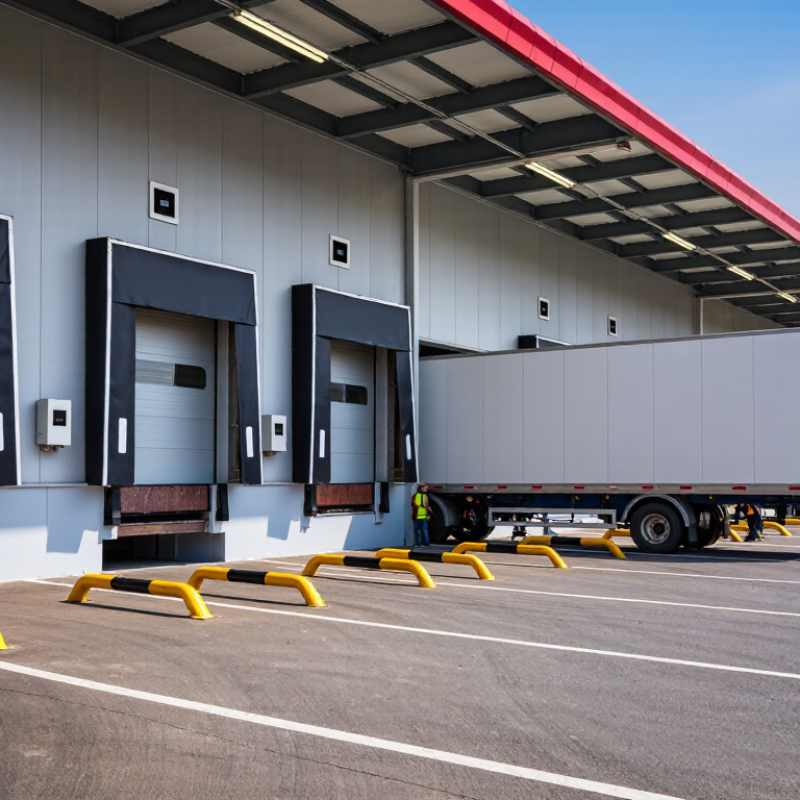
China’s top ten dock door manufacturers often serve warehouses, cold-chain facilities, factories, and distribution centers. Their product ranges usually include sectional dock doors, rolling steel doors, high-speed doors, and insulated doors. Each type solves a different operating problem. Sectional doors suit frequent loading bays and provide reliable thermal control. Rolling doors save overhead space. High-speed models reduce air exchange in temperature-sensitive areas.
Applications should guide the specification. A refrigerated warehouse may require insulated panels, heated seals, and corrosion-resistant hardware. A busy fulfillment center needs strong springs, fast opening cycles, and visible safety sensors. Dock shelters and dock levelers also matter. A door alone cannot correct a poor loading-bay layout. Measure the opening width, height, pit depth, vehicle range, and daily cycles before requesting quotations. Small measurement errors can cause expensive delays.
Global buyers should review test reports, material grades, control-voltage options, installation drawings, spare-parts availability, and warranty terms. Ask manufacturers to confirm wind resistance, insulation performance, emergency release, and compliance with destination-market standards. Factory audits, sample inspections, and video commissioning checks improve reliability. Yet paperwork is not proof of long-term performance. A cheaper door may use thinner panels or weaker hinges. That choice can appear sensible, but repeated repairs may erase the saving. Some specifications remain uncertain until installation, so buyers should document acceptance tests and allow room for technical revision.
Ranking China’s Top 10 by 10,000–100,000-Cycle Performance and Compliance
China’s top 10 dock door manufacturers are best compared through verified durability, not catalogue claims. This ranking focuses on doors tested from 10,000 to 100,000 operating cycles. It also reviews safety documentation, factory controls, and export experience. Cycle data matters because a busy warehouse may open a door hundreds of times each day.
The strongest suppliers provide test records showing how panels, hinges, rollers, springs, and operators perform over time. They should explain test conditions, load levels, maintenance intervals, and failure rates. Look for production systems aligned with ISO 9001 and product documentation supporting relevant regional requirements, such as EN 13241 or UL 325 where applicable. Compliance must match the destination market.
Certificates alone are not enough.
A 100,000-cycle laboratory result may not reflect dust, cold storage rooms, uneven floors, or careless impacts. I would request sample inspection reports, spare-parts lists, installation drawings, and references from comparable facilities. Ask difficult questions. Weak answers often reveal weak support.
For buyers, the most reliable ranking combines long-cycle evidence with practical engineering. A 10,000-cycle door may suit light traffic, while a 50,000-cycle model could offer better value for distribution centers. The highest-rated manufacturers should also disclose limitations instead of promising universal performance. That honesty is imperfect, but useful. It helps buyers compare lifecycle cost, safety risk, service access, and downtime before signing a purchase agreement.
Comparing 2.4–3.0 m Door Sizes, U-Values, Seals, and Safety Systems
China Top 10 Dock Door Manufacturers for Global Buyers
When comparing China’s leading dock door manufacturers, begin with the opening size. A 2.4 m door suits many standard loading bays. A 3.0 m door supports taller vehicles and faster material movement. However, larger openings increase air leakage, structural load, and operating cost.
U-values deserve careful review. Lower values usually indicate better insulation, but the tested panel alone does not represent the installed door. Frame joints, worn seals, and incorrect fitting can weaken performance. In practical projects, measured results are rarely perfect. Ask for test conditions, panel thickness, and installation details. A clear technical sheet is more valuable than a dramatic sales promise.
Seals should compress evenly against the dock face. Look for durable side seals, a top seal, and replaceable bottom contact areas. Small gaps can admit rain, dust, and cold air. Safety systems need equal attention. A suitable door may include a monitored safety edge, photoelectric sensors, emergency stop control, and manual release during power failure. Check whether these parts are tested together, not merely listed separately. Maintenance access also matters, especially for busy warehouses where a damaged seal may remain unnoticed. A factory inspection, sample door test, and documented spare-parts plan can reveal weaknesses before shipment. I would still question any specification that ignores local wind, temperature, traffic frequency, or operator training.
Verifying EN 13241, EN 12453, CE Marking, and ISO 9001 Credentials
China Top 10 Dock Door Manufacturers for Global Buyers?
A credible dock door supplier should provide more than a polished brochure. Ask for the exact EN 13241 test report, product model, door size, operating cycle, and test laboratory. Check whether the report matches the delivered configuration. A different motor or control panel can change the assessment.
EN 12453 focuses on the safe use of powered doors. Request evidence for closing-force measurements, photocell response, emergency release, and protective edges. Watch a live test if possible. The door should stop or reverse when an obstruction enters its path. Small details matter, especially at busy loading bays. CE marking is not a quality award. It indicates conformity with applicable European requirements. Request the EU Declaration of Conformity, technical documentation, and the applicable directives or regulations. Verify the manufacturer’s legal identity and document dates.
ISO 9001 supports confidence in production controls, but it does not certify every door model. Check the certificate’s scope, site address, validity, and certification body. A certificate covering only trading activities deserves careful questioning. Ask for batch records, inspection photos, calibration records, and a sample nameplate with a serial number. Factory experience helps here; documents often look complete until model codes are compared line by line.
There is room for doubt. Test reports may be genuine but outdated, translated poorly, or limited to one configuration. Installation quality also affects safety. A responsible buyer should inspect the factory, review maintenance instructions, and record acceptance tests after installation.
China Top 10 Dock Door Manufacturers for Global Buyers
Reference timeline for verifying EN 13241, EN 12453, CE Marking, and ISO 9001 credentials
This chart shows the relevant reference years for widely used European door-safety and quality-assurance credentials. EN 13241 is represented by its 2016 amendment, EN 12453 by its 2021 amendment, ISO 9001 by the 2015 edition, and CE Marking by the 1993 EU legislative reference. Buyers should request current declarations of performance, declarations of conformity, test reports, and valid ISO certification documents from each supplier.
Selecting Suppliers by MOQ, Lead Time, Warranty, and Total Cost of Ownership
China Top 10 Dock Door Manufacturers for Global Buyers?
For global buyers, a top-ten list should measure more than production scale. MOQ, lead time, warranty, and total cost of ownership reveal supplier reliability. The MHI 2024 Annual Industry Report found that 55% of supply-chain leaders planned to adopt robotics or automation within one to two years. This trend increases demand for compatible, dependable dock equipment.
MOQ affects cash flow and customization.
A low MOQ may suit one warehouse, but it can raise unit costs and spare-parts complexity.
Ask for written lead times covering engineering, production, inspection, and ocean freight. A practical target is a clearly defined delivery window, not a vague “fast shipment.”
Warranty terms should identify covered components, labor limits, response time, and exclusions. The 2023 World Bank Logistics Performance Index emphasizes timeliness and logistics competence, both useful when comparing export suppliers.
Tips:
Request three-year TCO estimates. Include purchase price, installation, energy loss, maintenance, replacement seals, downtime, and import charges. Check at least two operating references. One polished factory video is not evidence. A site audit or sample inspection is stronger. Also, do not assume the cheapest offer wins; a short warranty can quietly erase the initial saving. I would challenge my own ranking when service data is incomplete. That is often where procurement mistakes begin.