China Top 10 Residential Garage Doors Manufacturers?
China has become a major manufacturing base for residential garage doors, serving homeowners, builders, distributors, and overseas contractors. However, choosing a reliable supplier requires more than comparing factory prices. Door strength, insulation, motor compatibility, safety testing, finish quality, and after-sales support can affect daily performance for years.
Richard Kinch, a former president of the International Door Association, has emphasized, “The garage door is the largest moving object in your home.” That observation explains why supplier evaluation matters. A well-built door should move smoothly, close evenly, resist wind and moisture, and include dependable safety features. Small details matter. Think of reinforced hinges, sealed rollers, corrosion-resistant springs, and clearly documented installation limits.
This guide reviews China’s top 10 residential garage doors manufacturers through practical industry criteria. These include manufacturing experience, product range, customization ability, quality management, export performance, certifications, and service responsiveness. Some manufacturers focus on insulated sectional doors. Others specialize in aluminum, steel, glass, or custom architectural designs. The strongest option may not be the cheapest one.
A lower quotation can hide packaging risks, inconsistent components, or weak technical support. That deserves attention. Product pages also do not always reveal long-term field performance. Therefore, buyers should request samples, test reports, warranty terms, installation manuals, and recent project references before placing large orders.
The ranking is not absolute. Regional climate, building codes, opening dimensions, and project budgets can change the best choice. Still, this overview offers a clear starting point for identifying dependable Chinese manufacturers and comparing them with greater confidence.
What Defines a Leading Residential Garage Door Manufacturer in China?
A leading residential garage door manufacturer in China needs more than a large factory. It needs repeatable quality, verified testing, and clear technical communication.
Fortune Business Insights valued the global garage door market at USD 7.98 billion in 2023. Its report also forecasts continued growth through 2032.
China’s urbanization rate reached 66.16% in 2023, according to the National Bureau of Statistics of China.
These figures support stronger demand for reliable residential access systems.
Experience appears in small details.
A capable manufacturer checks panel alignment, spring balance, sealing pressure, and opener noise during production. It should provide documented cycle testing, wind-load data, safety-reversal results, and coating specifications.
Factory traceability matters too. Each motor, hinge, and panel batch should be identifiable after delivery. Some suppliers publish impressive test numbers, but the testing conditions are unclear. That weakness deserves attention.
Professional engineering also means adapting designs to China’s humid coastal areas, cold northern winters, and varied garage dimensions. A serious manufacturer follows applicable national and international requirements, while explaining limitations honestly.
It should maintain inspection records, installation guidance, spare-parts planning, and responsive after-sales support. Certifications help, but certificates alone do not prove field performance.
Real reliability is measured after repeated opening cycles, temperature changes, and imperfect installation. No factory gets every detail right. The better ones show how they find and correct those failures.
How China’s Top 10 Residential Garage Door Manufacturers Are Selected
Selecting China’s top ten residential garage door manufacturers requires more than checking factory size or online rankings. A credible review begins with documented experience. We examine production history, engineering staff, quality records, and completed residential projects. Factory visits can reveal practical details: clean assembly lines, calibrated testing tools, labeled components, and organized loading areas. These signs matter. Still, appearances can mislead. A polished showroom does not prove long-term reliability.
Professional selection also compares door materials, insulation performance, motor compatibility, safety sensors, weather seals, and noise control. We request test reports, installation instructions, warranty terms, and spare-parts policies. Independent certifications help, but their scope must be verified. Does the document cover the exact model? Is it current? Feedback from installers adds useful evidence because installers notice weak hinges, uneven tracks, and difficult adjustments. Delivery consistency and communication deserve attention too. A manufacturer may offer excellent engineering yet struggle with changing specifications. That weakness should not be hidden.
Tips: Build a scoring sheet before contacting suppliers. Give separate points for safety, durability, customization, production capacity, and after-sales response. Ask for samples, factory videos, and references from comparable housing projects. Test opening cycles when possible. Record defects, not just advantages. Price should be reviewed beside service life, installation labor, packaging quality, and replacement costs. We also allow room for uncertainty. Some evidence is incomplete, and rankings can change as factories improve or decline.
How China’s Top 10 Residential Garage Door Manufacturers Are Selected
Editorial evaluation framework based on the factors most relevant to residential garage door buyers and importers. The percentages represent the relative weighting of each criterion, not individual company results.
Product quality and safety compliance receive the highest weighting because residential garage doors must provide reliable operation, structural protection, and safe daily use.
Comparing Products, Materials, Features, and Manufacturing Capabilities
China’s top 10 residential garage door manufacturers should be compared beyond catalog prices. Fortune Business Insights’ 2024 market report projects global garage door growth at roughly 5% annually through 2032. That demand favors suppliers with stable production, replacement support, and export experience.
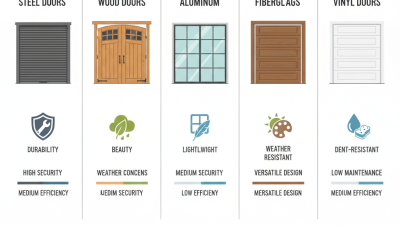
Material choice affects both performance and cost. Galvanized steel offers impact resistance and consistent panel forming. Aluminum reduces weight but may dent more easily. Wood provides a warmer appearance, though humidity demands stricter maintenance. Polyurethane-filled panels usually provide better insulation than unfilled panels. The U.S. Department of Energy recommends evaluating door insulation when conditioned garages connect with living spaces. That detail is often overlooked.
Check measurable capabilities, not polished photographs. Ask for panel thickness, insulation values, wind-load testing, spring-cycle results, and salt-spray records. A reliable factory should show traceability from coil receiving to final inspection. Production lines with automated foaming, CNC cutting, and balanced assembly can reduce variation. Still, automation alone proves little. A neat factory can hide weak after-sales systems. The World Bank’s logistics performance research also shows why delivery reliability matters for international buyers. Compare lead times, spare-part availability, packaging tests, and quality records across twelve months. Smart openers, safety sensors, and remote access add convenience, but software compatibility needs careful checking. I would not rank manufacturers by features alone. Real performance is quieter, safer, and less dramatic.
How to Choose the Right Chinese Residential Garage Door Manufacturer
Choosing the right Chinese residential garage door manufacturer starts with evidence, not attractive catalog photos. Ask how long the factory has produced residential systems and which markets it serves. A dependable supplier should provide traceable test reports, material specifications, and clear production procedures. Check steel thickness, insulation density, spring cycles, panel alignment, and the quality of hinges and rollers. Small details often reveal manufacturing discipline. That matters.
Request a working sample before placing a large order. Test its balance, noise level, sealing, and safety reversal function. Confirm whether the design meets the standards required in your destination market. Factory photos are useful, but a live video inspection can reveal storage conditions, welding quality, and packaging methods. Discuss customization carefully, including dimensions, surface finishes, motor compatibility, spare parts, and installation instructions. A professional manufacturer should answer with measurements and documents, not vague promises.
I once focused too heavily on the lowest quotation. The sample looked fine, but its accessories were inconsistent. That mistake changed my evaluation process. Compare total ownership cost, including replacement parts, warranty response, shipping protection, and technical support. Ask for references from comparable projects, while remembering that one successful order proves little. Communication also deserves testing: send a technical drawing and observe how accurately the engineering team responds. Reliable cooperation is built through repeatable checks, honest limitations, and written commitments.