Why Are Enclosure Boxes Important for Your Project?
An enclosure box may look like a small part of a project, but it protects components that keep the whole system working. It helps limit exposure to dust, moisture, accidental contact, and physical impact. Inside, terminals, circuit boards, and cable connections may sit close together. A secure enclosure helps keep them organized and reduces the risk of damage during installation or routine use. Small details matter.
Choosing Enclosure Boxes starts with the actual equipment and its surroundings. Check internal dimensions, mounting points, cable-entry locations, and room for ventilation. A box that fits the components but leaves no space for wiring can make installation difficult. For outdoor or damp locations, review the product’s stated ingress-protection rating and confirm it suits the conditions. A rating is not a substitute for correct installation, sealed cable entries, or regular inspection. Fit matters.
The right enclosure can also simplify maintenance. Removable covers, accessible fasteners, and clear space around components can make checks less frustrating. Material matters, too: heat, sunlight, chemicals, and impact may affect which option is appropriate. Manufacturer specifications are useful, but project conditions should guide the final choice. Still, an enclosure cannot correct poor wiring or an unsuitable design. That part deserves careful thought. Treat the enclosure as a functional project component, not an afterthought.
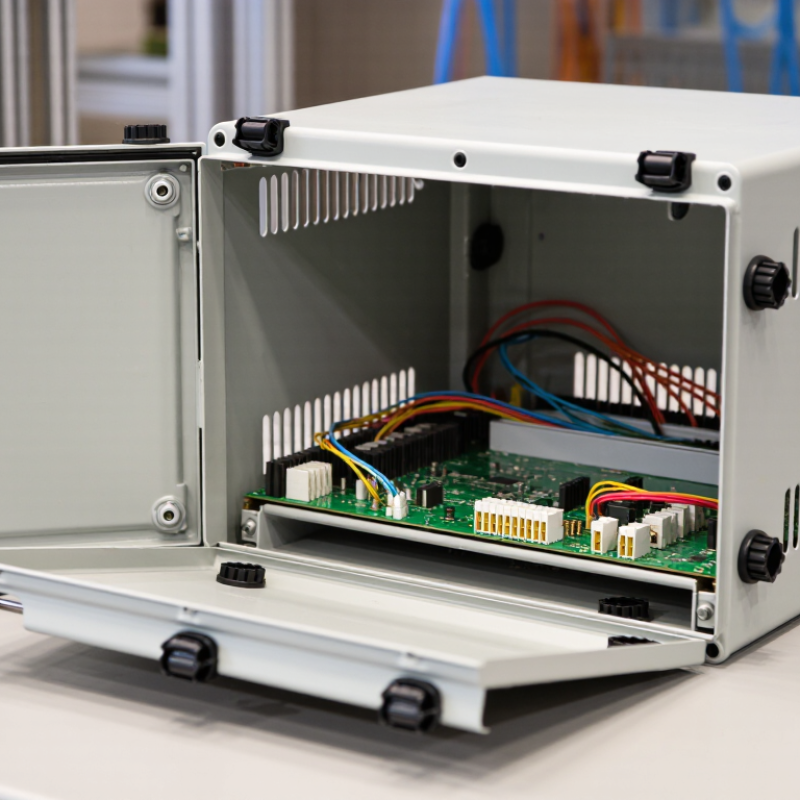
Enclosure Boxes Explained: Housing for Electrical and Control Components
An enclosure box is the physical housing for electrical and control components. Inside, you may find terminal blocks, relays, power supplies, circuit breakers, or a programmable controller. The box keeps these parts arranged and helps shield them from contact, dust, moisture, and impact. The level of protection depends on its design and rating. It is more than a cover.
Mounting rails, cable glands, and labeled terminals make a panel easier to wire and service. Leave room for cable bends and future repairs; a tightly packed box can turn a simple fault check into a frustrating task. Heat matters, too. Components generate warmth, while a sealed enclosure can limit airflow. Ventilation or cooling may be needed, but openings can reduce protection against the surrounding environment.
A box can look sturdy and still be wrong for the site. Consider indoor or outdoor use, temperature, corrosion, washdown, and the actual cable-entry points. Check component clearances and the enclosure’s rated protection before installation. Grounding and wiring should follow applicable requirements and be handled by qualified personnel. The parts list alone does not tell the whole story. A little spare space is useful, though too much can make a small panel awkward to mount.
Why Enclosure Boxes Matter: Understanding IP Ratings
Enclosure boxes house electrical and control components, helping protect them from dust and water. The chart compares the two digits in selected IP codes under IEC 60529: the first digit indicates protection against solid objects, and the second indicates protection against water. These digits are protection levels, not a linear measure of performance.
For example, IP65 indicates dust-tight protection and protection against water jets; IP67 adds protection against temporary immersion under specified test conditions. Choose an enclosure rating that matches the project’s environment and applicable requirements.
Environmental Protection: IP6X Is Dust-Tight; IPX7 Covers 1 m for 30 Minutes
An enclosure can look sealed and still let fine dust reach a terminal block. IP6X means dust cannot enter during the specified test. That matters in workshops, roadside cabinets, and sites where powder settles on every surface. Dust-tight is not the same as indestructible: worn seals, a poorly seated lid, or an unused cable entry can weaken the protection in real use.
IPX7 covers temporary immersion in water up to 1 metre for 30 minutes under defined test conditions. It can help protect equipment during brief flooding or accidental drops into shallow water. It does not automatically prove resistance to high-pressure jets, hot water, or long-term outdoor exposure. That distinction matters. IP6X and IPX7 describe separate tests; an enclosure needs both ratings to claim protection against both dust and immersion. Check the complete assembly, including glands and fasteners, not just the empty box. A rating is useful evidence, but installation and maintenance still count. It is easy to overestimate what a label promises, especially when a project’s conditions are harsher than the test.
Why Are Enclosure Boxes Important for Your Project? - Environmental Protection: IP6X Is Dust-Tight; IPX7 Covers 1 m for 30 Minutes
| Protection or Selection Factor | Rating or Data | What It Means | Project Relevance |
| Dust protection | IP6X | The enclosure is dust-tight: no dust ingress is permitted during the applicable IEC 60529 test. | Useful where dust could interfere with electrical contacts, moving parts, sensors, or cooling components. |
| Temporary immersion protection | IPX7 | The enclosure withstands temporary immersion in water under the specified test conditions, commonly summarized as up to 1 m for 30 minutes. | Relevant where accidental submersion or temporary flooding is a foreseeable risk. |
| Combined dust and immersion protection | IP67 | The “6” indicates dust-tight protection; the “7” indicates protection against the specified temporary-immersion test. | Consider when a project needs both dust protection and resistance to temporary immersion. |
| Water-jet exposure | Check the marked rating | IPX7 alone does not establish protection against water jets. Jet protection is assessed separately, such as under IPX5 or IPX6. | For washdown or spray exposure, verify the required water-jet rating rather than assuming IPX7 covers it. |
| Enclosure integrity in use | Depends on installation and maintenance | Gaskets, cable glands, covers, fasteners, and correctly sealed openings can affect the protection of the assembled enclosure. | Use compatible components, follow installation instructions, and inspect seals after servicing or modification. |
| Environmental conditions beyond ingress | Assess separately | IP ratings do not by themselves specify resistance to corrosion, UV exposure, impact, chemical contact, or temperature extremes. | Check these additional conditions when choosing enclosure materials and construction for the project location. |
Selection note: IP ratings are based on standardized tests and do not guarantee protection in every real-world installation. Confirm the required rating for the actual exposure and applicable project standards.
NEMA Type 4X: Corrosion Resistance and Protection from Hose-Directed Water
A NEMA Type 4X enclosure helps protect electrical equipment where corrosion and hose-directed water are practical concerns. Think of a washdown area: water strikes the cabinet, residue collects near seams, and damp air lingers after cleaning. The rating indicates protection against these conditions, along with windblown dust and rain. It does not mean the enclosure can be submerged. Small distinction, big consequence.
Corrosion is costly well beyond a single cabinet. NACE International’s IMPACT study estimated the global cost of corrosion at US$2.5 trillion annually, or about 3.4% of global GDP. A suitable 4X enclosure can reduce one source of equipment exposure, but it cannot prevent every failure. Material choice, cable entries, fasteners, and installation all matter. A neglected gasket can undermine a sound enclosure. That part is easy to overlook.
Tips: Check the rating against the actual cleaning method and site conditions. Inspect seals and fittings during maintenance, especially after repeated washdowns. If corrosion is already present, review nearby materials and drainage too; the enclosure may not be the only weak point.
Choosing Materials: Compare Steel, Aluminum, and Polymer for Project Conditions
An enclosure box protects electrical and control equipment, but its material must suit the site. A steel cabinet handles knocks from tools and routine maintenance well. It can be a sensible choice near machinery or where a rigid mounting surface matters. However, scratches can expose bare metal, so coatings and inspection deserve attention in damp or salty environments. Heavy boxes may also make installation harder.
Aluminum weighs less and resists corrosion in many outdoor settings. That can simplify mounting on poles or elevated structures. It also transfers heat readily, which may affect temperature-sensitive equipment in direct sun. Check the cabinet’s thermal design rather than assuming metal alone will keep components cool. Where dissimilar metals meet, suitable fasteners and isolation may help limit galvanic corrosion. Not always simple.
Polymer enclosures avoid rust and are often easy to handle. They can suit wet areas or locations where electrical insulation is useful. Yet sunlight, heat, impact, and chemical exposure vary by polymer type; a generic “plastic” description tells you little. Check the material data and enclosure rating against actual site conditions. The neatest choice on paper can still disappoint at installation. Compare access needs, mounting loads, cleaning agents, and expected temperature swings before specifying a material.
Installation and Compliance: Check UL 50E Ratings, Clearances, and Cable Entries
An enclosure can look substantial and still be wrong for the installation. Check its UL 50E Type rating against the actual environment, including dust, splashing water, corrosion, and indoor or outdoor exposure. A rating is not a blanket guarantee for every condition. The cover, gasket, fasteners, and installed fittings must also preserve the intended protection.
Plan clearances before mounting. Leave enough room to open the door, reach disconnects, and bend conductors without forcing them against sharp edges. Follow the equipment instructions and applicable electrical requirements; required spacing can vary with voltage, heat, and the components inside. Cable entries deserve equal care. Choose compatible hubs or glands, position them away from seams and hinges, and seal unused openings with suitable closures. A rushed hole near a gasket can undermine an otherwise sound enclosure. It is easy to miss that during layout.
Tips: Mark entry points on a full-size template before drilling. Check tool access and cable bend radius. After wiring, inspect the gasket and confirm the door closes evenly. Small details matter, though field conditions may still call for a second review.