Top 10 Truck Engine Brands for Global Buyers?
Choosing a Truck Engine is no longer just a question of horsepower. Global buyers must weigh fuel use, service access, emissions performance, parts availability, and total ownership costs. These factors change across routes and regions. A highway tractor in Europe faces different demands from a heavy-duty truck working remote mining roads.
The International Energy Agency’s Global EV Outlook 2024 reported more than 54,000 electric truck sales worldwide in 2023, about 1.2% of total truck sales. The figure is still small, but it signals a shifting market. ICCT research on heavy-duty vehicle efficiency also highlights why real-world performance matters alongside official ratings. As Mike Roeth, executive director of the North American Council for Freight Efficiency, puts it, “There is no silver bullet.” Buyers should treat that as a practical warning, not a slogan.
This guide compares ten major engine brands through the details buyers can verify: power options, fuel economy claims, emissions technology, dealer coverage, and maintenance support. A polished specification sheet is useful. A stocked parts counter, miles from the nearest city, may matter more. The rankings cannot capture every local condition, and that is a limitation worth stating plainly. Use them as a starting point, then check operating data and service networks in your own market.
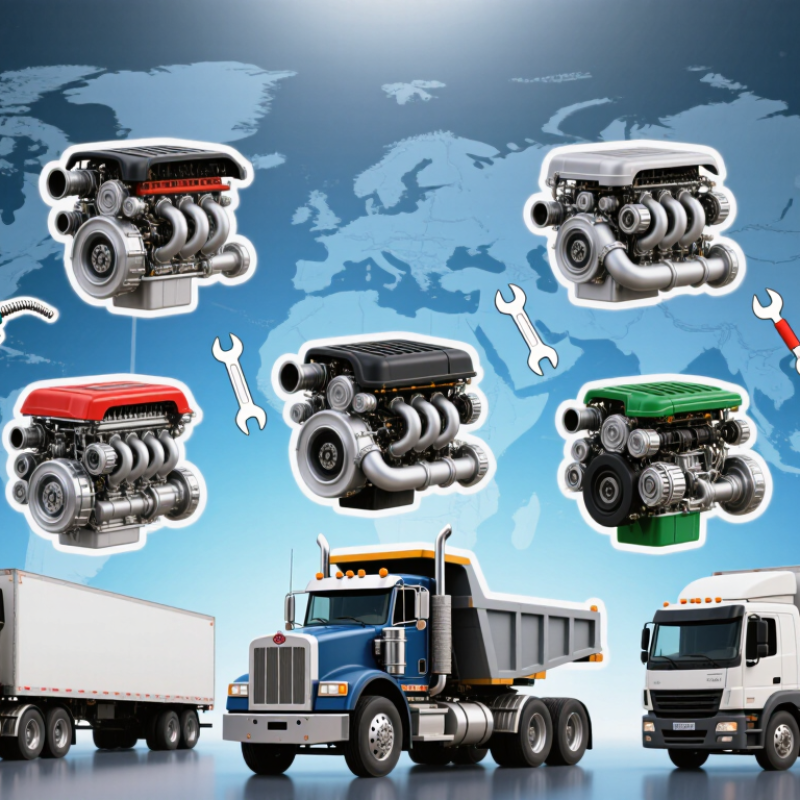
How Truck Engine Brands Differ Across Global Markets
Truck engine brands differ across global markets because roads, fuel, climate, and service access differ too. Buyers should compare engines by their working conditions, not just advertised power. A high-torque engine may suit heavy loads on steep routes, while a lighter-duty option can be more practical for frequent urban deliveries. The best fit depends on the truck’s real workload.
Emissions requirements and fuel quality also shape available configurations. An engine designed for one market may need different emissions equipment elsewhere, affecting maintenance needs and operating costs. In remote areas, access to trained technicians and replacement filters can matter as much as fuel economy. Hot weather, cold starts, high altitude, and dusty roads each place different demands on cooling and filtration systems. Small details matter. Published figures cannot fully predict performance on a specific route, and I would treat broad regional comparisons as a starting point, not a final answer.
Tips: Ask local fleet operators about service intervals, parts lead times, and fuel use under similar loads. Check whether nearby workshops can diagnose the engine’s electronic systems. Then compare total operating costs, not purchase price alone. One caveat: estimates can be imperfect, especially when routes and driving habits vary.
Truck Engine Markets: Diesel Fuel Sulfur Limits
Maximum sulfur content in road diesel fuel, in parts per million by mass (ppm).
Why it matters: Fuel quality and emissions regulations influence truck-engine and exhaust-aftertreatment requirements across markets. This chart compares fuel sulfur limits—not engine performance, sales, or brand rankings.
Reference limits: EU EN 590, U.S. ultra-low-sulfur diesel, Japan’s on-road diesel standard, China VI diesel specifications, and India BS VI fuel specifications. Values are maximum sulfur content by mass.
North American Leaders: Cummins, Caterpillar, Detroit Diesel, and PACCAR
North American truck-engine buyers usually compare more than horsepower. They weigh service coverage, parts access, fuel use, and repair time. Established diesel specialists often offer broad support networks. Heavy-equipment manufacturers may bring experience with demanding duty cycles. Some truck makers develop engines for close integration with their own vehicles. Independent suppliers can offer another route. The details vary by model and year.
Tips: Check the engine’s service history and local parts availability. Ask how long common repairs take. A nearby workshop can matter more than a small paper advantage in fuel economy.
For a long-haul fleet, steady highway performance and predictable maintenance may lead the decision. Regional operators might value easy access to filters, belts, and trained technicians. Compare warranty terms, emissions-system maintenance, and real-world fuel records from similar routes. A specification sheet is useful, but it cannot show every operating cost. I would also verify support before purchase; assuming a familiar engine means easy repairs can be a costly mistake. Real fleet data is sometimes incomplete, so treat unusually strong claims with care.
European Specialists: Volvo, Scania, Mercedes-Benz, and MAN
European truck-engine specialists are known for balancing high torque, long service intervals, and emissions control. Their heavy-duty platforms often serve regional haulage, construction, and long-distance fleets, where a loaded trailer must climb steadily without frequent gear changes. ACEA reported that EU truck registrations rose 16.3% to 346,986 units in 2023. That is market context, not proof that one engine suits every route.
In fleet comparisons, check the engine’s torque curve, rated output, and service requirements against your actual payload and terrain. A 13-litre engine may feel effortless on a steep motorway, yet be a costly fit for lighter, short-haul work. European makers also differ in cab integration, transmission tuning, and dealer coverage. These details matter at 5 a.m., when a truck is losing time in a cold depot. Specs alone can mislead. I would verify fuel use with a route-matched trial; published figures rarely capture every stop, hill, or driver habit.
Tips: Compare total operating cost, not purchase price alone. Ask for fuel and maintenance records from trucks running similar routes, and confirm local parts availability before choosing. A neat spreadsheet still misses downtime.
Asian Powerhouses: Isuzu and Weichai
Japanese and Chinese engine makers bring different strengths to the global truck market. Japanese designs often appeal to buyers seeking refined operation, consistent service support, and engines suited to frequent stop-and-start routes. Chinese manufacturers have expanded their reach with broad engine ranges, competitive configurations, and growing export networks. Their capabilities vary by model and market, so national reputation alone is not enough.
Look beyond headline horsepower. Check torque delivery at low engine speeds, fuel use under your typical load, and parts availability near your routes. A loaded truck climbing a dusty grade needs dependable cooling and accessible maintenance—not just impressive brochure figures. Real-world performance can differ. That deserves attention.
Tips: Ask for service records and maintenance intervals. Compare warranty coverage in writing. If possible, test a truck with a similar load and route before buying.
For either origin, confirm that the engine matches your transmission, axle ratio, and working conditions. Ask local technicians which components take longest to source, and whether diagnostic tools are readily available. A lower purchase price may not mean lower operating cost. I would be cautious about treating published fuel figures as guarantees; driving style, payload, terrain, and idle time can shift them considerably.
Top 10 Truck Engine Brands for Global Buyers? - Asian Powerhouses: Isuzu and Weichai
An anonymized buyer reference: the profiles below compare common truck-engine size and output bands, not individual manufacturers or brands.
| Buyer Profile | Typical Displacement | Common Configuration | Typical Rated Power | Typical Peak Torque | Common Applications |
| 01 — Light-duty | 2.0–3.0 L | Inline-four diesel | 75–140 kW (100–188 hp) | 250–500 Nm | Light trucks, delivery vehicles, and urban distribution |
| 02 — Upper light-duty | 3.0–5.0 L | Inline-four or inline-six diesel | 100–200 kW (134–268 hp) | 450–850 Nm | Regional delivery, utility trucks, and smaller rigid trucks |
| 03 — Medium-duty | 5.0–7.0 L | Inline-six diesel | 130–250 kW (174–335 hp) | 600–1,200 Nm | Medium rigid trucks, refuse collection, and local haulage |
| 04 — Medium-heavy | 7.0–9.0 L | Inline-six diesel | 170–320 kW (228–429 hp) | 800–1,600 Nm | Heavy rigid trucks, construction support, and regional freight |
| 05 — Heavy-duty | 9.0–11.0 L | Inline-six diesel | 200–370 kW (268–496 hp) | 1,100–2,100 Nm | Tractor units, long-haul work, and heavy rigid applications |
| 06 — High-output heavy-duty | 11.0–13.0 L | Inline-six diesel | 250–450 kW (335–604 hp) | 1,400–2,600 Nm | Long-distance freight and demanding heavy-haul routes |
| 07 — Extra-heavy | 13.0–15.0 L | Inline-six diesel | 300–500 kW (402–671 hp) | 1,800–3,000 Nm | Heavy haulage, high gross combination weights, and steep routes |
| 08 — Maximum-displacement | 15.0–16.0 L | Inline-six diesel | 330–560 kW (443–751 hp) | 2,000–3,200 Nm | Specialized heavy haulage and high-power tractor applications |
| 09 — Natural-gas option | 8.0–13.0 L | Inline-six spark-ignition gas engine | 180–400 kW (241–536 hp) | 1,000–2,200 Nm | Urban and regional fleets with suitable gas refueling access |
| 10 — Vocational high-output | 12.0–16.0 L | Inline-six diesel | 350–600 kW (469–805 hp) | 2,200–3,500 Nm | Mining, heavy construction, and specialized low-speed work |
How Buyers Compare Engine Support, Efficiency, and Total Cost
For global buyers, choosing a truck engine means looking beyond headline horsepower. Compare service coverage along regular routes, parts availability, diagnostic access, and technician training. A powerful engine can become costly if a basic sensor takes weeks to arrive. Ask for written maintenance intervals and warranty terms, then check whether local workshops can support them. Downtime costs money.
Efficiency depends on the work. Payload, terrain, idling, fuel quality, and climate all affect consumption. Request test data from duty cycles similar to yours, rather than relying only on laboratory figures. Check whether cooling systems and emissions equipment suit local conditions and repair capacity. Small fuel savings can add up over thousands of kilometers, but projections deserve caution. Real routes are messy.
Tips: Build a three-year cost sheet covering purchase price, fuel, scheduled service, repairs, downtime, and resale value. Get parts lead times in writing. Compare cost per operating hour, not just engine price. Keep a repair reserve. Forecasts miss things. Ask local fleet operators which components need attention and how long repairs take; their practical details may be more useful than a polished brochure.