NJ & NYC Commercial & Residential Garage Door
Choosing a Dashboard Instrument in 2026 means looking beyond a bright screen or polished bezel. The right unit must fit your vehicle, connect to compatible sensors, and show essential readings clearly in changing light. A crisp display can still be the wrong choice. Fit comes first.
The market is shifting toward more digital vehicle interfaces. The International Energy Agency’s Global EV Outlook 2024 reports nearly 14 million electric cars were sold worldwide in 2023, about 18% of all car sales. That change makes display flexibility increasingly relevant, but it does not make every digital cluster suitable for every vehicle. Check mounting dimensions, wiring, signal compatibility, voltage, dimming, and whether the display remains readable in direct sun. Numbers matter.
Dashboard design expert Stephen Few defines a dashboard as “a visual display of the most important information needed to achieve one or more objectives.” For drivers, that principle means prioritizing quick, legible readings over decorative graphics. Compare analog and digital options against your actual needs: speed, engine temperature, fuel level, or additional sensor data. Verify the manufacturer’s fitment information, warranty, and installation guidance before buying. A feature-rich instrument may add complexity you do not need. Not always. Consider how you drive, what your vehicle supports, and which readings you can check at a glance. A little uncertainty is useful here: product specifications do not always tell you how a display feels on a bright afternoon.
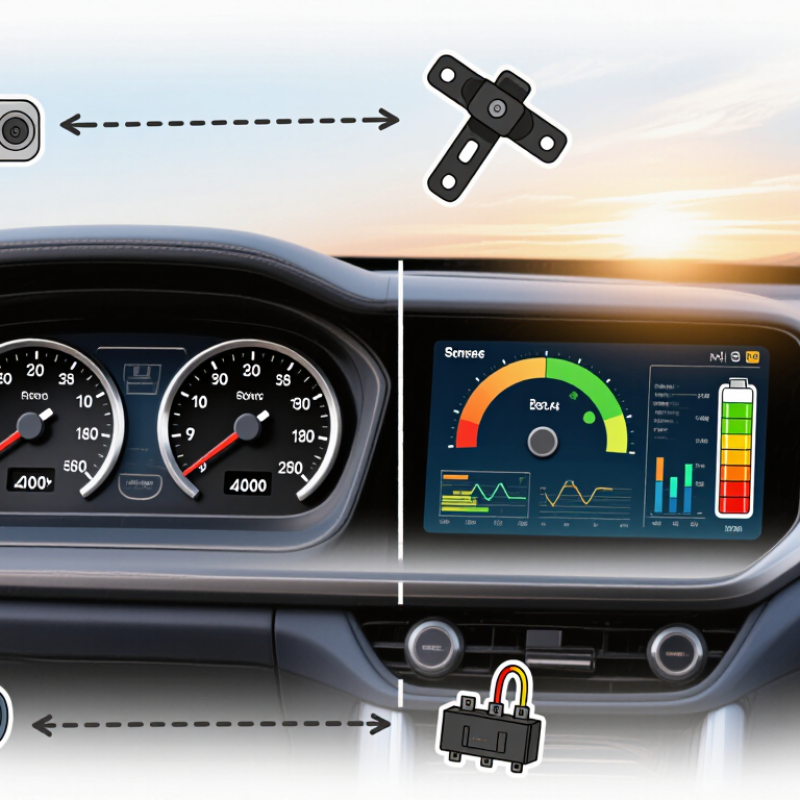
A dashboard instrument is a gauge or display that turns vehicle information into a signal a driver can understand. A speedometer shows movement; a fuel gauge estimates available fuel; a warning lamp flags a condition needing attention. Define its intended function before choosing its appearance. Is it for continuous monitoring, a quick decision, or an urgent alert? These jobs need different levels of detail.
Keep the main reading obvious. A speed display should be readable at a glance, while a warning indicator should stand apart from routine information. Picture a driver checking the fuel level on a bright afternoon: tiny labels, glare, or crowded graphics can make a simple reading harder. This distinction is easy to miss. More information is not always more useful.
The U.S. National Highway Traffic Safety Administration’s 2013 Visual-Manual Driver Distraction Guidelines use two-second individual glances and twelve seconds of total eyes-off-road time as task-evaluation criteria. These are design guidance, not a guarantee of safety or a universal legal requirement. They support a practical choice: prioritize the reading that matters most, then test legibility in daylight and at night. A display can look precise on paper and still feel awkward behind the wheel. It is worth questioning whether every number earns its space.
Choosing a dashboard instrument starts with the measurements operators actually use. List each variable, its normal operating value, and its expected peak. A coolant temperature display may spend most of its time near 90°C, yet still need to show brief spikes clearly. Match the range to these conditions; an oversized scale can hide small but important changes. Numbers matter. Check units, too. Mixing bar and psi, or Celsius and Fahrenheit, can prompt avoidable mistakes during a quick glance.
Accuracy should reflect the decision the reading supports. A control loop may need tighter tolerances than a broad status display. Include sensor error, wiring effects, and the instrument’s stated accuracy when estimating total uncertainty. NIST Technical Note 1297 explains that a coverage factor of 2 gives approximately 95% coverage under common distribution assumptions. That is a useful reference, not a guarantee for every setup. Ask for calibration records and confirm how accuracy is specified across the operating range. The awkward part: specifications can look excellent on paper while a cramped display remains hard to read in a vibrating cab. Check the digits, lighting, and response time in the actual viewing position. Not always. A modest range with legible increments may serve better than impressive precision nobody can use.
Choosing a dashboard instrument in 2026 starts with how you drive and what you need to see quickly. Analog gauges remain easy to read at a glance, even in bright sunlight. Fully digital displays can show speed, navigation, and driver-assistance alerts in one configurable layout. Hybrid instruments combine physical gauges with a screen, offering familiar movement and extra information. That balance can help. But more options can also mean more time spent adjusting menus.
Compare the display itself, not just its feature list. LCD screens are widely used and can remain readable in daylight, while OLED panels offer deep contrast but may need careful brightness management. A head-up display can place speed information near your line of sight, though glare and viewing position affect comfort. In 2026, expect more configurable layouts, clearer alerts, and tighter links between instrument displays and vehicle assistance systems. These features vary by vehicle, so check what remains visible during an alert or system change. Touch controls look tidy, but physical buttons can be easier to use on a rough road. Not always. Sit in the vehicle, adjust the seat, and check whether key readings stay clear without hunting through screens.
Choosing a dashboard instrument in 2026 starts with the vehicle, not the display. Check the exact model year, engine type, and supported diagnostic protocol. A connector may fit while the data connection does not. Small details matter. Confirm that the instrument can read the information you need, such as speed, coolant temperature, or battery status. For hybrid and electric vehicles, verify compatibility directly; their systems can differ significantly. Treat a compatibility chart as a starting point, then compare it with the vehicle manual or a qualified installer’s advice.
Installation and safety deserve equal attention. Place the display where it stays readable without blocking the road, factory controls, or airbag deployment zones. Test the viewing angle in daylight and at night. Test before trimming or attaching anything permanently. If installation requires wiring, follow the vehicle’s service instructions, including any battery-disconnection procedure, or ask a professional. A loose cable near the pedals is a real hazard. Also check how the instrument is powered and whether it may affect diagnostic functions or create distracting alerts. Specifications can be incomplete, and some displays show delayed or estimated readings. That limitation is easy to overlook, so keep the original warning lights and gauges in view.
How to Choose a Dashboard Instrument in 2026?
A dashboard instrument should fit its job, not just its screen opening. Compare the full installed cost: unit price, wiring, adapters, calibration, and labor. Ask for a written warranty and check what it excludes. A low purchase price can become expensive if a compatible sensor or replacement cable is hard to find. Check reliability through published operating-temperature ranges, vibration ratings, and clear installation instructions. If these details are missing, ask the supplier rather than assuming.
Tips: Confirm connector types before ordering. Request spare-part availability and support terms in writing. Test the display in bright sunlight and at night, if possible.
Long-term support matters after the initial installation. Find out how long firmware updates, technical help, and replacement parts are expected to remain available. Confirm that the instrument can still show essential readings if a connected feature fails. These checks are more useful than choosing by appearance alone. Still, no specification sheet predicts every installation problem; real-world fit can be less tidy than expected. Keep your measurements, settings, and purchase documents together for future service.
| Instrument option | Typical parts cost (USD) | Reliability considerations | Installation and compatibility | Long-term support outlook | Best suited for |
|---|---|---|---|---|---|
| New vehicle-specific replacement cluster | $300–$1,500+ | New electronics avoid prior wear, but reliability still depends on component quality, heat exposure, and correct configuration. | Usually the closest physical and electrical match. Programming or vehicle-specific setup may be required; professional labor is additional. | Potentially strong when matching connectors, documentation, and repair channels remain available. Confirm software and configuration support before purchase. | Owners seeking an original-style replacement and a close fit. |
| Remanufactured original cluster | $150–$700 | Failed components may be repaired or replaced, but results depend on the remanufacturing process and the condition of the remaining components. | Often retains the original housing and connectors. Vehicle configuration, odometer handling, and any required programming must be confirmed. | Ask about the written warranty, repair records, return process, and whether future repairs are offered. | Drivers who want an original-style unit at a lower cost than a new assembly. |
| Used instrument cluster | $50–$400 | Condition and remaining service life can be difficult to verify. Stored faults, worn displays, or prior moisture and heat exposure may not be apparent. | Part numbers and vehicle configuration must match. Odometer rules and programming requirements vary by jurisdiction and vehicle. | Usually the least predictable option. Support may be limited to the seller’s return window or short warranty. | Budget repairs when the part can be verified and a return option is available. |
| Aftermarket digital dashboard display | $250–$1,200+ | Fewer moving parts than mechanical gauges, but the display, wiring, sensors, and control module add potential failure points. | Compatibility varies by vehicle and data network. Check supported signals, warning lights, sensor requirements, and installation expertise. | Evaluate software update policy, replacement availability, documentation, and warranty length; continued support is product-dependent. | Custom builds or drivers who want configurable digital readouts. |
| Individual replacement gauges | $30–$250 per gauge | A failed gauge can be replaced independently. Overall dependability depends on the gauge, sensor, wiring, and installation quality. | May require new sensors, mounting, wiring, and calibration. Confirm measurement range and compatibility with the vehicle’s electrical system. | Common gauge formats and replaceable sensors can make future repairs straightforward, but parts support varies. | Older vehicles, custom dashboards, or repairs limited to one or two readings. |
| Planning note: Cost ranges are broad 2026 planning estimates for parts only, not quotes or measured market averages. Labor, programming, shipping, taxes, and calibration can add cost. Reliability descriptions are general design considerations, not failure-rate statistics. Verify fitment, warranty terms, local odometer requirements, and support availability for the specific vehicle and part before buying. | |||||